Practice and the track exam — department of Montevideo
The national rule sets what the exam is made of; the intendencia sets the maneuvers.
Step of the procedure: Pass the practical test
Facts checked on September 23, 2026 · Compiled by Alexander Zakalsky
What the source icons mean
official source — you can rely on ityou can rely on itunofficial source — check it on the spotcheck it on the spotneeds checking — plan for the worst caseplan for the worst case
The track: where each thing is done
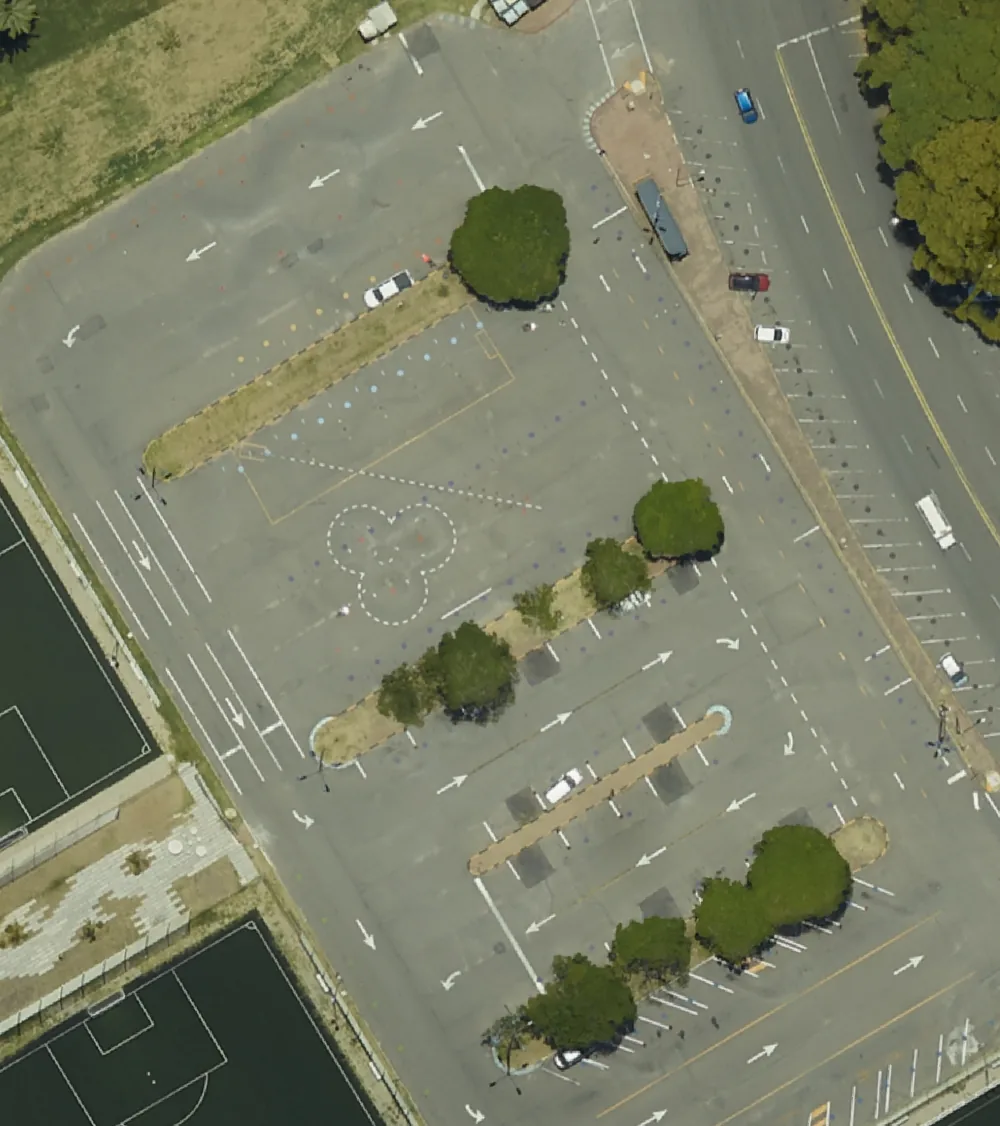
There is one track for all of Montevideo, and the maneuvers on it come in a fixed order set by the Intendencia’s protocol. Tap a number on the photo: it opens what that maneuver is, what you lose points for and the video clip of it.
Order of the exam
Tap an item — the description and the video segment open.
Show the facts about the track
The track is in Parque Batlle, across from the América stand of the Centenario stadium, with its exit onto Av. Federico R. Vidiella; coordinates −34.8952 −56.1547. The intendencia itself publishes the address neither on the card for the trámite, the official procedure, nor on the Licencias de conducir page: the place was established from the press, from the driving schools and from the orthophoto.
The finished license is printed right there, in Parque Batlle: the Contralor de Conductores office in the Velódromo, Av. Ramón Benzano 3471.
The practical exam is given on Saturdays too: the license pickup office has a separate Saturday schedule for «the Saturdays when exams are given».
One and the same accompanying driver and one and the same private car may enter the track no more than three times a month and seven times in a half-year. For someone retaking it with a friend and the friend’s car, that is the ceiling on attempts — even though the national rule puts no limit on attempts within the 180 days.
Before the exams start you can simply drive onto the track and practice — it is open. During working hours it is crowded: the driving school cars line up, and you wait your turn for a single run.
The maneuvers on video
Six clips: the five maneuvers of the protocol seen from above, plus the «pare» sign, which is where people fail most often. The footage is someone else’s: the authors are named under the set, and the timecode of each clip is on the icon over the frame.
Maneuver 3. Zigzag between cones8 s
The car zigzags between the cones without stopping. Speed is steady, and the driver keeps re-gripping the wheel without letting go.
Maneuver 4. Narrow passage12 s
A straight stretch between two rows of cones — twenty-seven meters of painted line, measured on the orthophoto. The driving school's on-screen caption reads: don't cross the lines, don't touch the cones.
Maneuver 5. Reverse4 s
The same corridor in reverse: straight between the same lines, without crossing them. The hazard lights go on before starting — that moment isn't in this clip, it was filmed from inside the car.
Maneuver 6. Parallel parking9 s
Pulling in against the curb of a raised island, between cones. The driving school's conditions appear at the end of the clip: eight maneuvers, don't touch the cones, no more than 30 cm from the curb.
Maneuver 7. Parking at 45°12 s
The car in an angled spot between cones, with yellow hatching alongside. The driving school's conditions: five maneuvers, don't cross the lines, don't touch the cones. The reverse entry itself, seen from above, isn't in this clip.
The «pare» sign inside the pista itself13 s
The car approaches the first sign — the on-screen caption reads «brake» — then the second one, under the trees: «stop one hundred percent». Both stand inside the pista, between the exercises and the exit.
The clips are other people’s: Footage by ACU, «Maniobras. Examen de conducción»; copy on the El Pela Uy Driving channel; ACADEMIA INSTRUCTORUY, «PISTA DE EXAMEN PRACTICO DE CONDUCIR EN MVD». The timecode of the segment is on the badge over the frame.
What they check before the exam
The car and the accompanying driver are checked before you get behind the wheel — that is where it most often ends.
Show the requirements
A requirement you have not met cuts the procedure short: you never get as far as driving.a document of the department of Maldonado
For the car: a photocopy of the propiedad with no debts, the MTOP permit if it applies, a valid SOA insurance policy.a document of the department of Maldonado
The car must carry no fines and no patente debt.
The car can be a private one or one from a driving school. The intendencia does not provide a car of its own.a document of the department of Maldonado
An accompanying driver is mandatory: a license of the right category, no fines and no sanctions. The age and the years of experience are a Montevideo requirement.
The accompanying driver’s document number is declared in advance.a document of the department of Maldonado
The accompanying driver comes to the track together with you.a document of the department of Maldonado
Failing and retaking
Failing a part, not showing up and not meeting a requirement all cost the same: one attempt.
The track under the Montevideo protocol: five maneuvers
The only list of maneuvers with grounds for failure officially published in the country is the protocol of the Intendencia de Montevideo. There are five maneuvers, and each has its own list of what fails you on the spot.
There are TWO protocols on the intendencia’s site: one of November 12 and one of December 4, 2013, and they do not agree. Neither is marked as repealed. Where they differ, the stricter requirement is the one printed here: preparing by the lenient one means losing on the track. The differences themselves are named below.
Show all five maneuvers
The first is the zigzag between cones, at a steady speed. You fail on the spot for taking the cones out of order, for touching or knocking over a cone, for engaging reverse to reposition and for coming to a full stop during the maneuver. Braking slightly to even out your speed counts as a minor fault.
The second is the narrow passage: go straight without touching a single boundary marker. You fail on the spot for brushing a cone, for driving onto the boundary line and for bringing the car to a full stop.
The third is reversing: back down the corridor keeping the car straight and at a steady speed. You fail on the spot for brushing a cone, for driving onto the line and for coming to a full stop. Minor faults: not turning the hazard lights on beforehand and not signaling the turn as you pull away again.
The fourth is parallel parking against the curb, on the left or on the right: the car goes between cones or markers, as if between two cars. You fail on the spot if you go over five maneuvers, if the maneuvers do not lead to the goal, if a marker is knocked over or a wheel rides up onto the curb. More than 30 cm from the curb, a car left crooked and a brushed marker are minor faults.
The later version of the protocol, the one of December 4, 2013, gives EIGHT maneuvers instead of five for that same parking and penalizes only beyond 50 cm, counting 30 to 50 cm as a minor fault. That same pair of versions differs on the zigzag as well: the later one fails you on the spot for a full stop, the earlier one counts it as a minor fault — there the stricter one is the later one, and it is the one that stands here.
On the track the number in use is 30, not 50: the caption on the frame of the ACU training video reads «Máximo 30 cm. del cordón», and the people who took the exam say the same. That is why the earlier version of the protocol is printed here: it is the one worth preparing by.
The fifth is parking at 45 degrees, and you have to back into it. You fail on the spot for brushing a cone or a marker, for driving onto the lines, for a wheel on the curb and for not completing the maneuver. Minor faults: going over five maneuvers and not turning the hazard lights on while signaling the maneuver.
The counting rule is the same for both stages: one serious fault and the stage is lost; two minor ones and it is lost as well.
The street under the Montevideo protocol, and what carries over after a failure
The second stage is an ordinary street. The national rule knows nothing of this, but Montevideo allows it: fail the street alone, and next time you drive the street and not the whole exam over again.
On the street you fail on the spot for going through a red light, for ignoring a «Pare» or a yield sign, for not respecting the right of way from the right, for speeding, for losing control of the car or of the wheel, for failing to judge the car’s size — and for any intervention by the examiner: with the dual controls, with the handbrake or by taking the wheel from his seat.
Minor faults on the street: driving one-handed, looking down at the gear lever from under your arm while moving, not signaling a maneuver and taking the wrong lane position when maneuvering or changing lanes. Two of those and the stage is lost.
Pass the track and fail the street, and next time you take ONLY the street. The examiner writes REPROBADO in red in your file and notes which stage was failed. This is an official exception to the national rule that failing one part means failing the whole exam.
What the protocol requires you to have with you: the original form started at Contralor de Conductores, your cédula, the national identity card, a valid mandatory insurance policy and a car in working order. And to arrive early, not on the exact minute.
The route is short and does not leave Parque Batlle: a loop around the stadium block, 10 to 20 minutes. By the accounts of the people who took it, it is either Ricaldoni up to the roundabout by the Football Museum, then Alfredo Navarro, Talcahuano, Las Heras and Santiago Gadea back to the track, or shorter still — Vidiella, Benzano, Merola, Ricaldoni, Av. Italia and back. There is no fixed route: the examiner picks it.
They almost always ask you to pull away uphill — the prueba de repecho, usually off the handbrake. That maneuver is in the protocol neither on the track list nor on the street list: it is settled practice among the examiners, and all three people who took the exam name it.
Caveats: other departments and rare cases
Maldonado does not publish a list of maneuvers and faults of its own. Below are the neighboring departments and the cases that do not apply to everybody.
Show the caveats
Category A is taken in a vehicle for up to 9 passengers and 4000 kg — a car or a camioneta.
Taking the exam in an automatic puts an «automatics only» mark on the license: in Montevideo that comes from the rule of the Digesto, in Canelones from the intendencia’s guide. For Maldonado there is no rule either way — ask before the exam.
The staff do have the list — ask when you pay or when you book.a document of the department of Maldonado
Canelones, under the same rule, names three maneuvers: parking, turning around and reversing.
Better not to film the exam on your phone: the examiners may take it as filming their work and get stricter.a document of the department of Maldonado
Under the Canelones guide the accompanying driver answers for the car and has to bring it to the place of the exam himself, and then collect it from wherever the exam ended. That is, he drives before the start and after the finish, not you. Whether that rule holds in Montevideo and in Maldonado, their documents do not say.